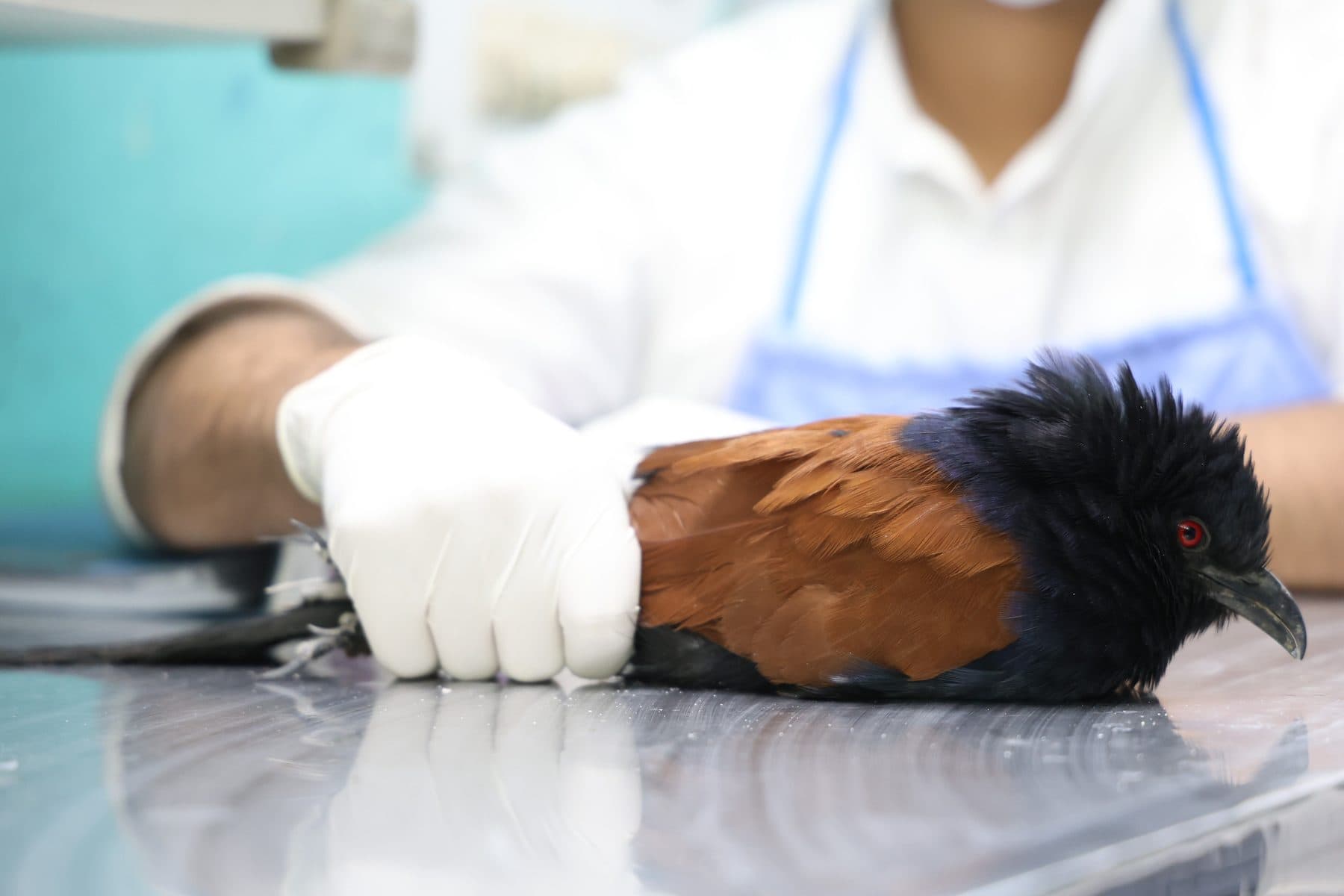
Centropus sinensis
The Greater Coucal is one of Delhi's most distinctive but often-overlooked birds — a large, ground-hunting cuckoo with striking chestnut wings and a deep booming call. Wildlife Rescue treats roughly 10 per year, usually after collisions or cat attacks.
of total intake
treated annually
Dense scrub, thickets, gardens, and the edges of cultivation across the Indian plains. In Delhi, found in overgrown parks, the Ridge, and wooded urban patches with thick undergrowth.
Resident across South and Southeast Asia — from Pakistan and India through Bangladesh, Sri Lanka, and into China and Indonesia.
Opportunistic omnivore — insects, caterpillars, small reptiles, frogs, eggs and nestlings of other birds, and occasionally fruit. Often described as a ground-hunting predator.
Body length 48 cm, weight 250–350g. Large crow-sized bird with glossy black head and body, deep chestnut wings, and a long graduated tail. Striking red iris.
A non-parasitic cuckoo — unlike most cuckoos, the Greater Coucal builds its own nest and raises its own young. Solitary and skulking, often heard before seen — its deep, resonant 'coop-coop-coop' call carries through scrubland at dawn.
Loss of dense undergrowth as parks and wastelands are 'cleaned up.' Pesticide poisoning (secondary, from insect prey). Window collisions when flying low between bushes. Cats.
Despite belonging to the cuckoo family, the Greater Coucal is one of the very few non-parasitic cuckoos in the world — it raises its own young rather than dumping eggs in other birds' nests. Its tail and short rounded wings make it look more like a pheasant than a typical cuckoo.
Your donation directly funds the rescue and rehabilitation of Greater Coucals and other birds in Delhi.
