Tyto alba
The Barn Owl is one of the most effective natural pest controllers on the planet. Their presence in Delhi should be celebrated, not feared. Wildlife Rescue treats ~130 Barn Owls annually, mostly juveniles that fall from nesting sites.
of total intake
treated annually
Old buildings, temples, ruins, farmland edges, and cavity-rich trees. In Delhi, they favor heritage structures and abandoned buildings in older neighborhoods.
One of the most widespread birds in the world — found on every continent except Antarctica. The Indian subspecies (T. a. stertens) is resident across the subcontinent.
Specialized rodent hunter. Hunts almost exclusively at night using extraordinary hearing — can locate prey in complete darkness. A single Barn Owl family can consume over 3,000 rodents per year.
Body length 33–39 cm, wingspan 80–95 cm, weight 250–480g. Heart-shaped facial disc is distinctive.
Strictly nocturnal. Silent flier due to specialized feather structure that muffles wing noise. Nests in cavities — buildings, tree hollows, and nest boxes.
Habitat loss as old buildings are demolished. Rodenticide poisoning (secondary poisoning from eating poisoned rats). Vehicle collisions at night. Superstition — some communities consider owls unlucky, leading to persecution.
An adult Barn Owl at Wildlife Rescue — heart-shaped facial disc, one of the most effective natural pest controllers on the planet
A Barn Owl at Wildlife Rescue — footage from our rehabilitation work with these silent nocturnal hunters
A Barn Owl released back to the wild after recovery — silent takeoff into the night, exactly what every rescue is working toward.
A Barn Owl in care at Wildlife Rescue — these silent nocturnal hunters are one of the most effective natural pest controllers on the planet
A Barn Owl chick at Wildlife Rescue — orphaned owlets receive round-the-clock hand-feeding and thermoregulation until they develop flight feathers and can be released
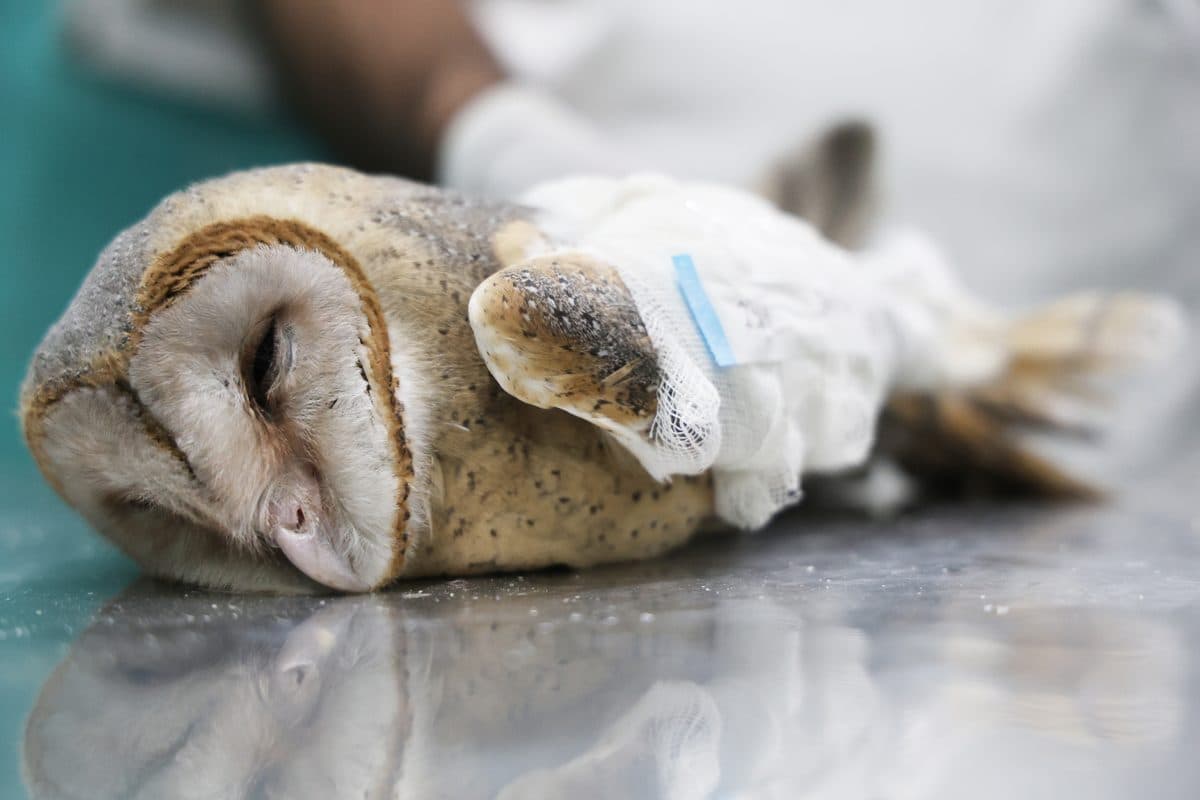
A Barn Owl with wing bandaging at Wildlife Rescue — careful immobilization is critical for fracture healing in these delicate nocturnal raptors
A bandage being applied to a Barn Owl's wing — for a wound caused by entanglement in manja (glass-coated kite-flying thread). Even nocturnal birds aren't safe from manja, which stays strung across Delhi's skies long after kite-flying festivals end.
A Barn Owl can hear a mouse's heartbeat from 30 feet away. Their asymmetric ears allow them to pinpoint prey in three dimensions using sound alone.
Your donation directly funds the rescue and rehabilitation of Barn Owls and other birds in Delhi.
